
Buying Composite Decking and Railing: Key Supplier Checks
Sourcing composite decking and railing from China requires more than comparing board samples and quotations. Overseas buyers need to establish whether a supplier manufactures the products, understand how its specifications vary by product range, and check whether the proposed materials suit the intended installation environment. Factory location and access to export ports also affect the sourcing decision.
Verify the manufacturer behind the quotation
The first check is whether the listed supplier operates its own production facility. A trading company may offer products from several factories, which can be useful for consolidating orders, but buyers should understand who controls production and quality. Ask for the factory’s registered business details, production address, equipment list and recent photographs or videos showing the manufacturing process. A genuine manufacturer should be able to explain its extrusion equipment, raw material preparation, moulding arrangements and production capacity without relying entirely on generic product descriptions.
Ask which stages are completed in-house and which are subcontracted. Some suppliers manufacture decking boards but purchase railing components, connectors or accessories from other businesses. That arrangement is not necessarily a problem, but it creates additional quality-control points. Buyers should also request clarification on whether the quotation comes directly from the production facility or through an intermediary. Consistent answers about production, packaging and inspection responsibilities are a useful indication of how the supplier manages its operations.
Compare specifications, not just samples
WPC products can look similar while differing in composition and performance. Buyers should request technical information covering the wood and polymer content, board dimensions, wall thickness, profile structure, surface treatment and available colours. Solid and hollow profiles have different weight and structural characteristics. A capped board also differs from an uncapped product because its outer protective layer changes the surface construction and expected weathering behaviour.
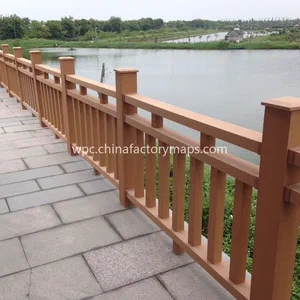
Samples should be checked against the proposed production specification. Examine the board’s dimensions, surface consistency, edge finish and colour across multiple pieces. Ask whether the sample represents the standard production model or a customised version. Railing requires separate attention: post dimensions, rail profiles, baluster spacing, fixing methods and connection components should all be documented. A supplier that can provide a complete system drawing is easier to assess than one offering individual components without showing how they fit together.
Material performance needs realistic evaluation. WPC resists moisture and insect damage better than untreated timber, but it is not indestructible. Temperature changes cause expansion and contraction, so installation requires appropriate gaps and a ventilated substructure. Sustained ultraviolet exposure can also fade colour. Buyers should request relevant test information and installation guidance rather than accepting broad claims about weather resistance or maintenance-free performance.
Assess location, logistics and order control

China’s mapped WPC supplier base is concentrated in several manufacturing regions. Guangdong has the largest listed cluster, including Foshan, Guangzhou and Zhuhai. Anhui includes suppliers around Xuancheng, Suzhou and Guangde, while Shandong has mapped activity around Zibo, Linyi and Qingdao. Zhejiang includes Huzhou, Jiaxing and Hangzhou. Shanghai and Jiangsu, including Nanjing, also appear in the directory. These locations provide a starting point for comparing factories geographically, rather than assuming that suppliers offering similar products have equivalent logistics arrangements.
Port distance should be assessed alongside factory location. Shanghai Port, Ningbo-Zhoushan Port, Shenzhen Port, Qingdao Port and Guangzhou Port are among the export gateways covered by the directory. Other mapped ports include Tianjin Port, Xiamen Port, Taicang Port, Beibu Gulf Port, Rizhao Port, Lianyungang Port and Yingkou Port. A nearby port may reduce inland transport requirements, but the actual shipping arrangement depends on the factory’s dispatch location, available transport routes, container loading facilities and freight arrangements. Request the proposed loading port and clarify whether inland transport and export handling are included in the quotation.
Before placing an order, establish how production batches will be inspected and approved. Ask for the production schedule, packaging method, pallet dimensions and loading photographs. Confirm whether different colours or profiles can be mixed within one shipment and how customised specifications affect lead times. Packaging deserves particular attention because long decking boards can be damaged during handling and transport. Agree on an inspection procedure before production begins, including how dimensional deviations, surface defects and damaged components will be recorded.

Questions that expose sourcing risks
A useful supplier assessment focuses on details that are difficult to answer with a catalogue alone. Buyers should ask for the raw material specification, production process, quality inspection records and explanation of any subcontracted components. Request confirmation that future orders can follow the approved sample and technical drawing. Changes in polymer content, recycled material proportions or surface construction may affect product consistency, so these details should be documented rather than left to verbal agreement.
Installation responsibility is another common source of disputes. Ask for the recommended joist spacing, fastening system, expansion gaps, ventilation requirements and railing connection details. Confirm whether the supplier provides compatible accessories and replacement components. A low quotation may exclude important fittings or assume an installation method unsuitable for the destination market. Buyers should also establish how colour variation between production batches is handled and whether replacement boards can be supplied in the same profile.
Finally, compare suppliers using the same specification and delivery basis. A factory offering a lower unit quotation may have different board dimensions, packaging arrangements or included accessories. Check the production address against the directory location, confirm the actual export port and obtain written agreement on product specifications, inspection and delivery responsibilities. These checks help distinguish a competitive manufacturing offer from a quotation that leaves important costs and responsibilities unresolved.
FAQ
Q: How can buyers distinguish a WPC factory from a trading company?
A: Request the registered business details, production address, equipment information and evidence of in-house manufacturing. Ask which components or production stages are subcontracted.
Q: Does a shorter distance to an export port always mean lower shipping costs?
A: No. Inland transport routes, container availability, loading arrangements and freight services also affect the total logistics cost.
Q: What technical details should be confirmed before ordering WPC decking and railing?
A: Confirm material composition, profile dimensions, surface construction, colour, railing connections, installation gaps, substructure ventilation and inspection requirements.
Related Articles
Featured Suppliers
Verified premium suppliers on our map.
