
Choosing Between Grooved and Square Composite Decking Suppliers
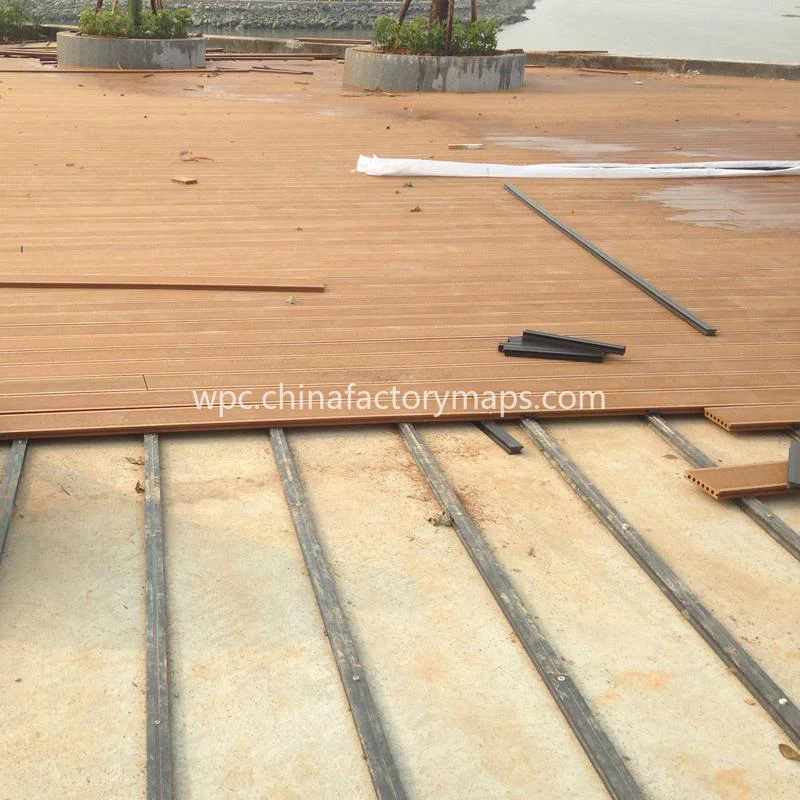
Selecting a supplier for grooved or square-edge composite decking involves more than comparing board profiles. Factory location affects the available supplier pool, export routing and the practical cost of moving finished goods. Buyers can use geographic clustering to narrow their search before assessing production capability, board specifications and quality controls.
How geography narrows the supplier shortlist

China’s mapped WPC manufacturing base is spread across several provinces, with different levels of supplier concentration. Guangdong has the largest listed cluster, with 22 suppliers across Foshan, Guangzhou and Zhuhai. Anhui follows with nine, including manufacturers in Xuancheng, Suzhou and Guangde. Shandong has seven, while Zhejiang has six. Shanghai and Jiangsu account for smaller groups.
These concentrations provide a useful starting point for sourcing. A larger cluster gives buyers more nearby suppliers to compare, which can make it easier to identify differences in product ranges and manufacturing specialisation. Guangdong is a logical first search area for buyers seeking several quotations within one regional market. Anhui offers another substantial group, while Shandong and Zhejiang provide additional options.
Cluster membership should not be treated as proof of manufacturing quality. Suppliers located in the same province may have very different production arrangements. Some may operate dedicated extrusion lines, while others may rely on outsourced processing or concentrate on trading. Geographic proximity helps organise enquiries; it does not replace factory verification.
Comparing board profiles and factory capabilities
Grooved and square profiles require attention to different product details during supplier assessment. Grooved boards have channels along their exposed surface, while square-edge boards have a flatter profile and typically require a different approach to edge finishing and fastening. The correct comparison depends on the intended installation system, not simply the appearance of the sample.

Buyers should request technical drawings for both profiles, including board dimensions, wall thickness, weight, material composition and dimensional tolerances. The underside structure also matters. Internal ribs, cavity arrangements and reinforcement affect stiffness and should be checked against the manufacturer’s stated specifications.

Surface treatments require separate examination. Embossing, brushing and capped surface layers can influence appearance and performance. Colour consistency between production batches is another relevant check, particularly for projects requiring large quantities of matching boards. Composite materials also respond to temperature changes through expansion and contraction. Installation instructions should specify suitable board gaps, fastening arrangements and ventilation beneath the deck.
A supplier offering both profiles should be able to explain whether they use dedicated tooling, interchangeable dies or different production arrangements. Buyers should also establish whether samples come from the same production process used for commercial orders. A showroom sample alone does not demonstrate consistency across a full shipment.
Location, export access and supplier verification
Factory location becomes particularly relevant when estimating the logistics of an overseas order. Guangdong suppliers can be assessed in relation to Shenzhen Port and Guangzhou Port. Zhejiang manufacturers may be evaluated against Ningbo-Zhoushan Port, while Shanghai and Jiangsu suppliers have access to Shanghai Port and Taicang Port. Shandong manufacturers can be compared with Qingdao Port and other listed regional export gateways.
The nearest port on a map is not necessarily the port used by a factory. Inland transport arrangements, freight forwarder relationships, container availability and the destination market can all influence the final routing. Buyers should request the actual loading port, factory dispatch location and recent shipping arrangements before comparing logistics quotations.
Factory vetting should establish who controls production. Request a factory address, production-line photographs or a live inspection, and documentation identifying the manufacturing entity. Confirm whether extrusion, surface finishing, cutting and packaging take place at the same facility. Where processes are subcontracted, the supplier should identify which stages are handled externally.
Product testing deserves equal attention. Ask for relevant test reports covering mechanical properties, water absorption, dimensional stability and resistance to weather exposure. WPC resists moisture and insect damage better than untreated timber, but it is not indestructible. Sustained ultraviolet exposure can cause colour fading, and product performance depends on formulation, surface treatment and installation conditions.

Using the factory map in the sourcing workflow
The chinafactorymaps.com directory plots 49 mapped WPC suppliers across the six listed provincial and municipal clusters. Its geographic structure allows buyers to begin with a regional shortlist rather than approaching manufacturers without considering their locations. Filtering by supplier location and distance to export ports provides a practical way to organise initial research.
A useful workflow starts by selecting the product profile and identifying factories in relevant manufacturing clusters. The next step is to compare technical specifications and confirm whether each supplier actually manufactures the required board design. Only then should buyers request quotations, samples and logistics information. This order reduces the risk of spending time evaluating suppliers whose production capabilities or shipping arrangements do not fit the project.
The map is a sourcing reference, not a quality certification or endorsement. Listed suppliers still require independent checks, and map distance should not be confused with a confirmed transport quotation. Buyers should maintain separate records for product specifications, factory verification, commercial terms and port arrangements. Keeping these checks distinct makes supplier comparisons more useful when several factories offer similar grooved or square-edge decking.
FAQ
Q: Does a larger WPC supplier cluster indicate better manufacturing quality?
A: No. A larger cluster offers more suppliers for comparison, but individual production capability, quality controls and product consistency must be verified separately.
Q: Should buyers always select the factory closest to an export port?
A: No. Port distance is one logistics consideration. Actual transport arrangements, shipping routes, freight costs and production suitability should also influence supplier selection.
Related Articles
Featured Suppliers
Verified premium suppliers on our map.
