
Hollow vs Solid Composite Decking: Comparing Material Costs
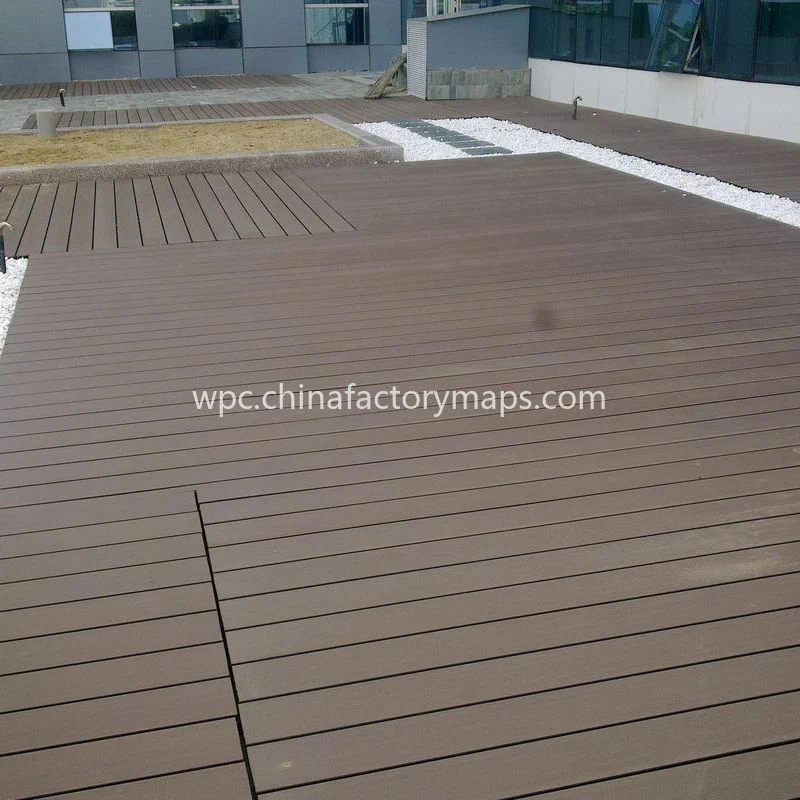
Hollow and solid WPC decking use similar wood-plastic composite formulations, but their internal construction affects material consumption, board weight and installation requirements. For overseas buyers comparing supplier quotations, the distinction matters because the lowest board price does not necessarily translate into the lowest installed material cost.
Construction and Material Differences

Hollow composite decking contains internal cavities running along the length of each board. These may form several chambers separated by reinforcing webs, depending on the extrusion design. The cavities reduce the amount of raw material required per unit of board length. This generally produces a lighter product and can lower manufacturing material consumption. However, wall thickness and internal geometry determine how much structural support the board provides. Two hollow boards with identical external dimensions can have substantially different material content.
Solid composite decking has a more substantial cross-section, with no continuous internal cavities. It generally requires more WPC compound per metre than a comparable hollow profile. That additional material increases board weight and usually raises the initial material cost. The denser section can provide greater resistance to localised loading and edge damage, although actual performance depends on the formulation, profile dimensions and manufacturing quality. Solid construction should not automatically be treated as proof of higher load capacity.
Material composition also affects the comparison. WPC commonly combines wood fibre or flour with thermoplastic polymers and additives. Differences in polymer content, wood particle size, coupling agents and processing conditions influence density, dimensional stability and surface quality. A low-density solid board and a heavily reinforced hollow board may perform differently from their profile labels alone. Buyers should request cross-sectional samples and technical specifications rather than compare products solely by their advertised construction type.
Comparing Material Costs and Applications

The immediate cost difference starts with material consumption. Hollow profiles generally use less compound, making them suitable for projects where board weight and initial material expenditure are important considerations. They are frequently considered for residential terraces, garden paths and balcony applications with appropriately designed supporting structures. Their lower weight can also reduce handling effort during packing, transport and installation. However, savings at the board level must be assessed against the complete deck specification.
Solid boards are often considered for areas subject to heavier foot traffic, more demanding edge conditions or frequent movement of outdoor furniture. Their greater material content can provide a more substantial section, but this does not eliminate the need for correct joist spacing and fastening. Buyers should compare the manufacturer’s tested load performance, recommended support intervals and fixing details. A solid board that requires closer joist spacing may increase the total project cost even if its performance characteristics are attractive.
Hollow construction introduces specific installation considerations. Open board ends may require compatible end caps or other protective detailing, while internal cavities must be considered when specifying drainage and edge finishes. Fasteners should follow the manufacturer’s approved installation method. Excessive tightening can damage fixing areas, particularly where the profile walls are relatively thin. Solid boards may offer more flexibility for certain edge and fastening details, but they also require compatible clips or screws and sufficient support beneath the board.

Neither construction removes the need to account for WPC’s thermal movement. Composite boards expand and contract as temperatures change, so installers must maintain the specified end gaps, side clearances and perimeter spacing. A ventilated substructure helps manage moisture beneath the deck and supports heat dissipation. WPC resists moisture and insect damage better than untreated wood in many applications, but it is not indestructible or absolutely waterproof. Sustained ultraviolet exposure can also cause colour fading, regardless of whether the profile is hollow or solid.
For sourcing comparisons, the quoted price should be separated from the actual material requirement. Board dimensions, weight per metre, coverage width, usable length and profile tolerances all influence the amount purchased. A composite decking cost calculator can help organise estimates when buyers enter the required deck area, board coverage and installation allowance. It should also account for cutting waste, edge boards, starter clips and replacement material. Without consistent measurement assumptions, comparisons between supplier quotations can be misleading.
Factory location adds another cost consideration for international orders. Chinafactorymaps.com plots WPC suppliers across Guangdong, Anhui, Shandong, Zhejiang, Shanghai and Jiangsu, allowing buyers to examine manufacturing clusters and their proximity to export ports. Guangdong listings include Foshan, Guangzhou and Zhuhai, while Anhui listings include Xuancheng, Suzhou and Guangde. Buyers can compare geographical sourcing options against ports such as Shenzhen Port, Shanghai Port, Ningbo-Zhoushan Port and Qingdao Port. The nearest port is not necessarily the final shipping route, so inland transport, consolidation arrangements and export handling should be checked separately.
FAQ
Q: Is hollow composite decking always cheaper than solid decking?
A: Hollow profiles generally use less raw material, but final pricing depends on profile dimensions, formulation, manufacturing quality and order specifications.
Q: Which construction is better for high-traffic outdoor areas?
A: Solid decking may suit applications requiring a more substantial cross-section. Actual suitability depends on tested load capacity, joist spacing and installation specifications.
Q: What should buyers compare when requesting factory quotations?
A: Compare board dimensions, weight, material composition, profile drawings, technical test results, fastening requirements and export logistics on a consistent basis.
Related Articles
Featured Suppliers
Verified premium suppliers on our map.
