
Solid vs Hollow Composite Decking: Understanding Board Gaps
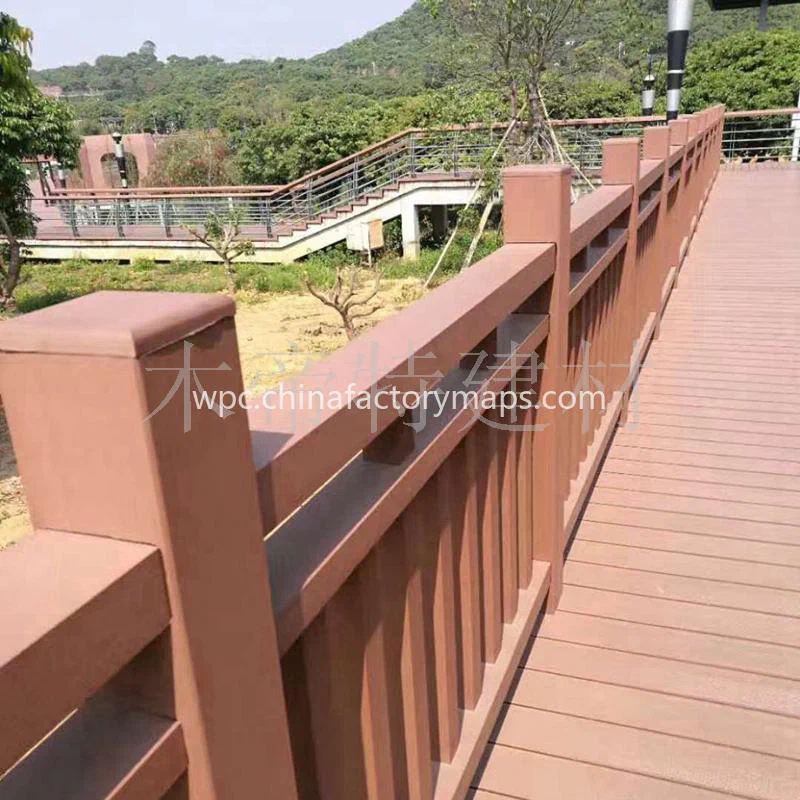
Solid and hollow WPC decking boards differ in internal structure, weight, material use and installation requirements. These differences affect how boards respond to temperature changes, how they are fastened and how much space should be left between adjacent boards. For buyers comparing Chinese manufacturers, understanding these construction details helps match board specifications to the intended installation.
How Solid and Hollow Boards Differ

Solid composite decking has a relatively dense cross-section, with material extending through the board rather than forming continuous internal cavities. This construction generally gives the board greater mass and can provide better resistance to localised loading, depending on its profile, formulation and dimensions. Solid boards are often considered for areas where the deck may experience concentrated foot traffic or where the exposed board edges need a substantial appearance. However, a solid profile is not automatically stronger in every application. Resin content, wood-fibre distribution, extrusion quality and internal density all influence performance.
Hollow decking contains one or more internal chambers running along the board. These cavities reduce material consumption and make individual boards lighter, which can simplify handling during transportation and installation. The trade-off is that wall thickness and chamber geometry become important structural variables. Thin chamber walls may be more vulnerable to damage from inappropriate fastening or concentrated loads. Buyers should examine cross-sectional drawings rather than relying on labels such as single-hole, multi-hole or round-hole. The spacing and thickness of internal webs affect stiffness, while the outer walls determine how well the board accommodates screws, clips and edge loading. Both profiles can be manufactured with different WPC formulations, surface textures and capped or uncapped constructions.
Board Gaps and Thermal Movement
Board spacing is a functional installation requirement, not simply a matter of appearance. WPC contains polymer components that expand and contract as temperatures change. The amount of movement depends on the polymer type, board dimensions, colour, manufacturing formulation and temperature range at the installation site. Longer boards can produce more noticeable cumulative movement than shorter sections. Dark surfaces may also absorb more solar heat, increasing the temperature difference between the board surface and surrounding air.
The correct composite decking gaps therefore depend on the manufacturer’s installation specifications and the conditions at the project location. Side-to-side spacing allows for expansion and provides drainage between boards. End-to-end gaps accommodate longitudinal movement, while perimeter clearances prevent boards from pressing against walls or other fixed structures. These measurements should not be treated as interchangeable. A board may have adequate side spacing but still experience problems if its ends are installed too close together.
Hollow and solid profiles can behave differently because their mass, wall geometry and heat distribution are not identical. Nevertheless, neither profile eliminates thermal movement. Installation teams should follow the specified gap measurements for the exact product rather than applying a universal clearance to every WPC board. Ventilation beneath the deck is equally important. A properly designed substructure allows air circulation and helps moisture drain away, reducing the risk of persistent damp conditions and uneven temperature exposure.

Fastening, Loading and Project Suitability
Fastening requirements create another practical distinction. Hollow boards may require compatible hidden clips or screws positioned according to the manufacturer’s instructions. Fixings placed too close to unsupported chamber edges can cause cracking or local deformation. Solid boards offer more material for certain screw-fixing arrangements, but this does not mean that arbitrary screw placement is acceptable. Pilot holes, edge distances, screw type and fastening depth must follow the product specification. Excessive tightening can restrict movement or damage the board.

For residential balconies and light-traffic garden decking, hollow profiles may offer a practical balance between handling weight and material use. Solid profiles can be considered for commercial walkways or applications involving more demanding loading conditions, provided the tested load capacity and supporting structure meet project requirements. Neither profile should be selected on appearance alone. Joist spacing, support conditions, fastening systems and the expected use of the deck determine whether a particular board is suitable.

Moisture resistance also needs careful interpretation. WPC generally resists moisture absorption better than untreated timber and is less susceptible to insect attack. However, it is not indestructible or absolutely waterproof. Water can collect around poorly drained structures, and prolonged exposure can affect components or supporting materials. Surface colour may also fade under sustained ultraviolet exposure. Buyers comparing products should request information about dimensional stability, UV performance, loading tests and recommended installation conditions.
For overseas procurement, factory location can help narrow the supplier shortlist, but it does not establish product quality. Chinafactorymaps.com plots WPC manufacturers across Guangdong, Anhui, Shandong, Zhejiang, Shanghai and Jiangsu, allowing buyers to compare geographic distribution and proximity to export ports. Guangdong suppliers may be relevant to shipments through Shenzhen Port or Guangzhou Port, while manufacturers in Zhejiang can be assessed in relation to Ningbo-Zhoushan Port and Shanghai Port. These are logistical reference points, not guarantees of shipping cost or lead time. A useful supplier enquiry should request a board cross-section, material specification, fastening details, installation gap recommendations and evidence of relevant performance testing. Comparing those documents against the intended project conditions provides a more meaningful basis for choosing between solid and hollow construction.
FAQ
Q: Do solid WPC boards require smaller gaps than hollow boards?
A: Not necessarily. Required spacing depends on the specific product’s dimensions, formulation and thermal movement data, so the manufacturer’s installation instructions should determine the clearance.
Q: Are hollow composite decking boards suitable for commercial projects?
A: They can be suitable when their wall thickness, structural performance and supporting joist arrangement meet the project’s loading requirements. Product-specific test data should be checked before selection.
Q: Can WPC decking boards be installed directly against a wall?
A: No. Appropriate perimeter clearance is needed to accommodate thermal expansion, and the substructure should provide adequate ventilation and drainage.
Related Articles
Featured Suppliers
Verified premium suppliers on our map.
