
Using Red Composite Decking Colors in Poolside and Garden Projects
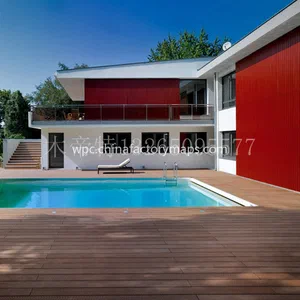
Red composite decking can be used around swimming pools, garden paths, outdoor dining areas and landscaped terraces, but each application places different demands on the boards. Colour selection is only one part of the specification. Buyers also need to assess slip resistance, surface temperature, UV exposure, drainage and the performance of the supporting structure. For overseas projects sourcing from China, the choice of manufacturing region can also affect export logistics and supplier selection.
Selecting Red Tones for Poolside and Garden Settings
Red composite decking colors range from muted reddish brown and cedar tones to deeper mahogany and terracotta shades. Around a swimming pool, a medium or darker red can provide contrast against pale paving, blue water and green planting. In a garden, warmer reddish tones often work with timber furniture, stone borders and natural landscaping. The intended visual effect should be assessed alongside the board’s surface characteristics, since colour alone does not indicate material quality or outdoor performance.

Sun exposure changes the practical considerations. Darker boards generally absorb more solar energy than lighter surfaces, which can make them uncomfortable under bare feet during hot weather. This matters particularly around outdoor pools, where users frequently walk without footwear. Buyers should request surface-temperature information under relevant exposure conditions and, where possible, test physical samples outdoors. Colour samples should also be viewed in direct sunlight and shade because the apparent tone can change considerably between the two settings.
Poolside installations require particular attention to slip resistance. Water, sunscreen and organic debris can all affect surface traction. A board described as anti-slip should be assessed using documented test information, with the test method and wet-condition results clearly identified. Embossed grain, brushed textures and grooved surfaces may influence grip, but none should be accepted as proof of performance without supporting evidence. The board profile also matters: deep grooves can retain dirt and leaves, increasing cleaning requirements around drainage channels and pool edges.
Specifying Boards for Climate and Installation Conditions
Coastal projects introduce another set of requirements. Salt-laden air, persistent moisture and strong sunlight can affect exposed decking and its supporting components. WPC generally resists moisture absorption and insect damage better than untreated timber, but it is not indestructible or completely waterproof. Buyers should ask manufacturers about the intended exposure conditions, water absorption characteristics and suitability of the product for coastal installations. Fasteners, clips and other metal components also need appropriate corrosion resistance. A composite board may perform adequately while unsuitable fixings cause premature problems elsewhere in the installation.
Freeze-thaw conditions require a different assessment. Water entering surface defects or collecting around poorly drained joints can freeze and expand. Buyers serving colder markets should request information on low-temperature impact resistance, dimensional stability and performance after relevant freeze-thaw testing. Installation instructions must account for temperature-related movement. WPC expands and contracts as temperatures change, so boards need specified end gaps, side clearances and appropriate fixing arrangements. The required spacing should come from the manufacturer’s installation guidance rather than assumptions based on timber decking.
The substructure is equally important. A ventilated support system allows moisture to drain and reduces the risk of water remaining trapped beneath the deck. Joist spacing must match the board’s thickness, profile and expected loading. Poolside areas, garden walkways and outdoor dining terraces may experience different traffic levels, so the specification should identify pedestrian loading, furniture loads and any concentrated loads from planters or outdoor equipment. Heavy foot traffic also makes abrasion resistance and surface wear relevant. Buyers should request technical drawings, recommended joist spans, fastening details and guidance for steps, perimeter edges and access panels before approving an order.

Sourcing from China’s WPC Manufacturing Clusters
China’s mapped WPC supplier base is distributed across several manufacturing regions, giving buyers different geographic starting points for sourcing. Guangdong has the largest listed cluster, with 22 suppliers across locations including Foshan, Guangzhou and Zhuhai. Its position in southern China makes it a relevant area to investigate for projects involving coastal developments, resort landscaping and outdoor residential spaces. Buyers can compare suppliers within the cluster while checking their experience with capped decking, textured surfaces and colour consistency. Proximity to Shenzhen Port and Guangzhou Port may also be relevant when evaluating export arrangements.

Anhui has nine listed suppliers, including businesses mapped in Xuancheng, Suzhou and Guangde. Shandong has seven, with mapped locations including Zibo, Linyi and Qingdao. Zhejiang contributes six suppliers around Huzhou, Jiaxing and Hangzhou, while Shanghai and Jiangsu have smaller listed clusters. These regions provide additional options for comparing board profiles, manufacturing capabilities and project specifications. Shandong’s location is relevant to buyers assessing northern export routes, while Zhejiang suppliers may be considered alongside access to Ningbo-Zhoushan Port. Shanghai and Jiangsu suppliers can also be evaluated in relation to Shanghai Port and Taicang Port.
A geographic shortlist should lead to a technical comparison, not an automatic purchasing decision. For red poolside and garden decking, buyers should request physical samples, colour references, production tolerances, cross-sectional drawings and installation documentation. It is useful to establish whether the colour is integrated throughout the board or applied as a surface layer, and whether the product uses a protective co-extruded cap. Co-extrusion can provide an additional protective surface, but its actual value depends on the cap material, thickness, bonding quality and tested performance. Buyers should also ask how colour batches are controlled across repeat orders, particularly when a project requires matching boards for separate installation phases.
Port distance is another useful filtering factor, although it does not determine the final delivered cost by itself. The directory covers Shanghai Port, Ningbo-Zhoushan Port, Shenzhen Port, Qingdao Port, Guangzhou Port, Tianjin Port, Xiamen Port, Taicang Port, Beibu Gulf Port, Rizhao Port, Lianyungang Port and Yingkou Port. Comparing factory locations against these export gateways helps identify possible logistics advantages. The final assessment should also consider inland transport, container loading, packaging protection and the supplier’s experience preparing decking for overseas shipment. Long boards need particular attention during handling and packing to reduce the risk of damaged edges, warped profiles or inconsistent bundles.
FAQ
Q: Are darker red composite decking boards suitable for swimming pool areas?
A: They can be suitable, but darker surfaces may become hotter under direct sunlight. Buyers should assess surface temperature and wet-condition slip resistance before selecting a colour.
Q: What should buyers request when sourcing WPC decking for coastal gardens?
A: Request information on moisture resistance, UV performance, dimensional stability and corrosion-resistant fixing components. Installation details should also specify drainage, ventilation and expansion gaps.
Q: Which Chinese regions should buyers compare for red composite decking?
A: Guangdong, Anhui, Shandong and Zhejiang are useful starting points because they contain mapped supplier clusters. Factory location should be compared with technical capabilities and access to suitable export ports.
Related Articles
Featured Suppliers
Verified premium suppliers on our map.
