
What Determines the Cost of Composite Deck Boards?
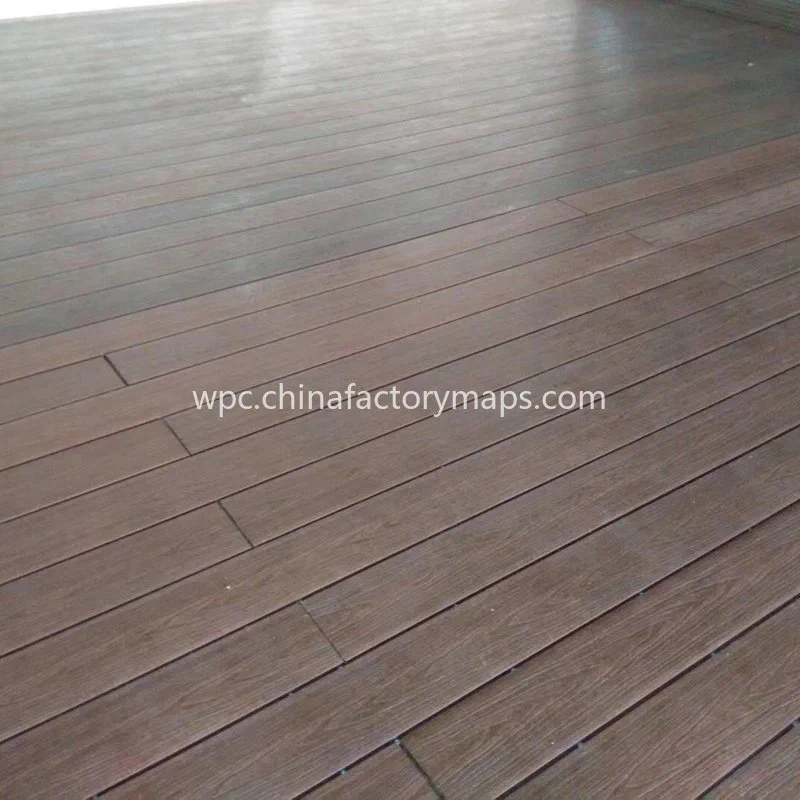
Composite deck boards cost is determined mainly by material composition, board construction, surface treatment and manufacturing requirements. The final price also depends on order volume, production location, packaging and the distance between the factory and the export port. Buyers comparing quotations need to separate the cost of the board itself from the costs of getting it ready for delivery.
Material composition and board construction
The raw material mix is one of the main influences on manufacturing cost. Wood-plastic composite (WPC) decking typically combines wood flour or other plant-based fibres with thermoplastics and additives. The proportions matter. A higher wood content does not automatically mean a cheaper or better board, because material quality, processing requirements and the intended performance all affect the formulation.
The type of plastic also influences cost. Different thermoplastics have different processing characteristics and material prices. Recycled polymers may reduce raw material expenses, but their consistency needs to be assessed. Variations in recycled feedstock can affect colour, surface appearance and production stability. Additives for UV resistance, colour retention and other performance requirements add to the formulation cost. Buyers should therefore compare technical specifications rather than relying on the term WPC alone.
Board construction is another important distinction. Solid boards generally use more material per unit of length than hollow profiles of comparable external dimensions. Hollow boards can reduce material consumption and shipping weight, although their internal structure and wall thickness affect strength and suitability. Solid profiles may be preferred for certain applications, but they are not automatically superior. The intended span, support spacing and expected loading should guide the choice. Board dimensions also matter: greater thickness, width or length usually requires more material and can affect production efficiency.

Surface technology, finish and production requirements
Surface treatment creates another layer of price variation. Standard WPC boards may have a single-colour, brushed or embossed finish. More elaborate surface textures require additional tooling or processing. These details influence appearance and production costs, but a higher-priced finish does not necessarily indicate better structural performance.
Co-extrusion is a more substantial construction difference. In capped or co-extruded decking, an additional polymer layer surrounds the composite core, providing a protective outer surface. This can improve resistance to staining, moisture exposure and surface wear, depending on the materials and manufacturing quality. It also adds material and production steps. Co-extruded boards generally cost more than comparable uncapped products. Buyers should check the cap material, coverage and bonding quality rather than treating all capped boards as equivalent.
Colour selection can affect the quotation too. Standard production colours are often easier to schedule than less common shades or custom finishes. Special colour matching may involve additional material preparation, production adjustments and quality checks. Custom embossing, profile shapes and private-label requirements can also add expense. These costs are particularly relevant to OEM orders, where the buyer specifies dimensions, branding or packaging rather than selecting an existing factory product.
Manufacturing consistency deserves attention alongside the quoted specification. Poor temperature control or inconsistent extrusion can produce dimensional variation, uneven surfaces and differences between production batches. A supplier with tighter process controls may quote more than a supplier offering a visually similar board. Buyers should request samples and confirm that the sample specification matches the product intended for mass production.

Order volume, factory location and export logistics
Order quantity affects the unit cost through production efficiency. Larger orders can spread tooling, setup, inspection and packaging expenses across more boards. They may also give a factory greater flexibility when purchasing raw materials. Smaller orders, by contrast, can carry a higher unit cost because production lines still require preparation and adjustment. However, a large order does not guarantee a better commercial outcome if the buyer has not confirmed product consistency, delivery arrangements and usable stock requirements.
Factory location also enters the calculation. China’s WPC suppliers are not concentrated in a single manufacturing area. The directory maps supplier clusters across Guangdong, Anhui, Shandong, Zhejiang, Shanghai and Jiangsu. Each area has different access to industrial inputs, manufacturing infrastructure and export routes. These differences can influence production overheads and transport costs, although province alone is not a reliable indicator of the cheapest supplier.
Port distance is particularly relevant for overseas buyers. A factory located near an export port may have lower inland transport costs and a simpler route for container loading. Guangdong suppliers can be compared in relation to Shenzhen Port and Guangzhou Port, while factories in Zhejiang may be assessed against Ningbo-Zhoushan Port. Shanghai and Jiangsu suppliers can also be evaluated in relation to Shanghai Port and Taicang Port. Shandong factories may have access to Qingdao Port or Rizhao Port, depending on their location.

The directory’s geographic view helps buyers compare these distances before requesting quotations. It does not establish that a nearby factory will always offer the lowest delivered price. Inland trucking, container availability, local handling charges and shipping arrangements all affect the final calculation. A supplier farther from a major port may still offer a lower total cost if its factory quotation is sufficiently competitive.
Packaging and shipment preparation should be included in the comparison. WPC boards are generally bundled and protected for transport, with packaging requirements depending on board length, surface finish and destination handling conditions. Export orders may require additional labelling, palletisation or customised packaging. Container loading efficiency matters too. Board dimensions and packaging design determine how much product fits into a shipment, which affects freight cost per unit.
Buyers should request quotations that separate board specifications, packaging, inland transport and export-related charges wherever possible. A factory-gate price is not directly comparable with a quotation that includes delivery to port. The same applies to shipping terms: the responsibilities and costs included in a quoted trade term need to be clear before comparing offers.
A practical comparison should begin with the same technical specification for every supplier. Confirm board dimensions, solid or hollow construction, material composition where disclosed, surface treatment, colour, intended application and applicable test information. Then request sample boards and check dimensional consistency, finish and physical condition. Installation requirements matter as well. WPC expands and contracts with temperature, so boards need the specified expansion gaps and a ventilated substructure. The material resists moisture and insects, but it is not indestructible, and sustained UV exposure can cause colour fading. These characteristics affect product suitability and long-term ownership costs, even when they do not appear in the initial quotation. Comparing suppliers on a consistent specification, with transport costs accounted for separately, gives buyers a more useful basis for assessing price differences.
FAQ
Q: What is the biggest factor affecting composite deck board cost?
A: Material composition and board construction are major cost factors. Solid profiles, co-extruded surfaces and specialised formulations generally require more material or additional processing.
Q: Are hollow WPC decking boards cheaper than solid boards?
A: Hollow boards typically use less material and can cost less to manufacture. Their suitability depends on profile design, wall thickness, support spacing and intended loading.
Q: Does choosing a factory near an export port reduce the total cost?
A: It can reduce inland transport and handling expenses, but the factory quotation and shipping arrangements also matter. Buyers should compare the complete cost to port rather than factory price alone.
Featured Suppliers
Verified premium suppliers on our map.
