
What Is Wood-Grain Composite Decking and How Is It Made?
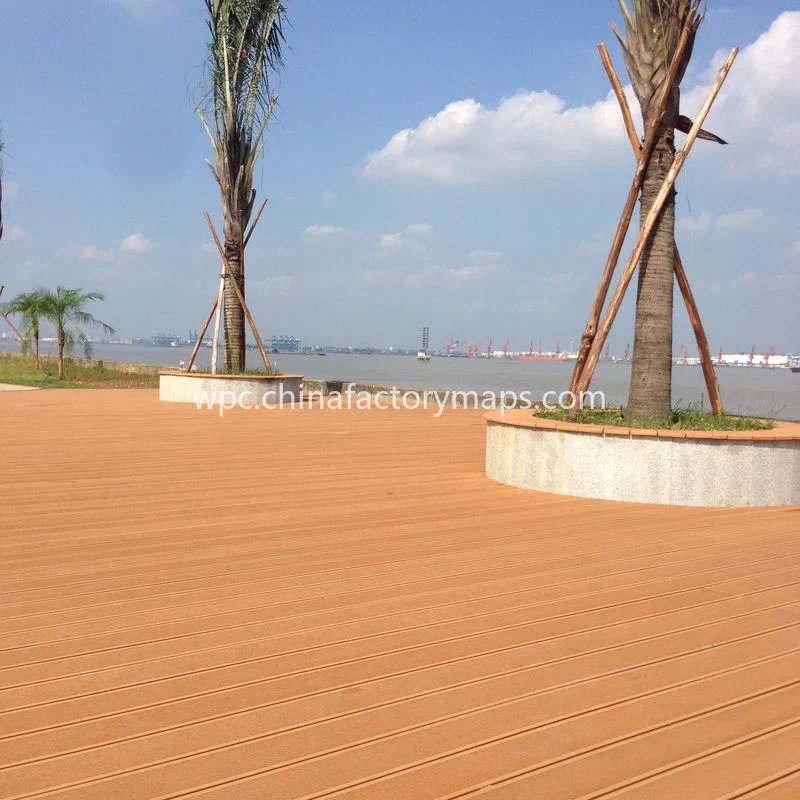
Wood-grain composite decking is a wood-plastic composite (WPC) decking board manufactured to reproduce the appearance of natural timber while using a mixture of wood fibres and thermoplastic materials. Its grain pattern is formed during manufacturing through surface texturing, embossing or other finishing processes, giving the board a timber-like appearance without relying on solid wood throughout its structure.
The term composite wood grain decking describes a product category rather than a single manufacturing method. Boards can differ in their raw material ratios, production processes, surface treatments and internal construction. These differences affect appearance, dimensional stability, moisture resistance and suitability for outdoor applications. Buyers comparing suppliers should therefore look beyond the surface pattern and examine how the board itself is produced.

Materials and Manufacturing Process
The main ingredients in WPC decking are wood-based material and thermoplastic resin. Wood flour, wood fibres or other processed plant materials provide much of the board’s structure and contribute to its timber-like appearance. Common thermoplastics used in WPC manufacturing include polyethylene (PE), polypropylene (PP) and polyvinyl chloride (PVC). The selected polymer influences processing requirements and the physical properties of the finished product.

Manufacturers also introduce additives to improve processing and product performance. These may include coupling agents, stabilisers, pigments, lubricants and other formulation components. Coupling agents help the wood-based material and polymer bond more effectively, while pigments determine the base colour. Stabilising additives can help limit degradation during processing and outdoor exposure. The exact formulation varies between factories and product specifications. Recycled plastics and reclaimed wood materials may also be used, although their presence and proportion should be confirmed with the manufacturer rather than assumed from the WPC label.
Production generally begins with preparing the raw materials. Wood flour or fibres are dried to reduce moisture content, while the plastic is processed into a suitable form for blending. The materials are then mixed with additives according to the manufacturer’s formulation. This stage matters because uneven moisture levels, inconsistent particle sizes or poor material distribution can affect the finished board. The prepared mixture is fed into an extrusion system, where heat and mechanical pressure soften the polymer and move the combined material through a shaped die. The die determines the board’s cross-sectional profile, including whether it has a solid or hollow structure, internal ribs or drainage channels. After extrusion, the board is cooled, calibrated and cut to the required length. Surface finishing may take place during or after this process.
The wood-grain appearance is created through a separate surface-design consideration. Some manufacturers use embossing rollers to press a grain pattern into the surface while the material is still warm enough to accept the texture. Others apply brushing, sanding or additional finishing techniques to create variations in the visible grain. Colour can be integrated into the material itself or applied through a surface treatment. These methods produce different visual results. A pressed grain pattern may create a regular texture, while brushing can expose variations in the surface and produce a less uniform appearance. Buyers should request physical samples because photographs alone do not reliably show grain depth, surface sheen or colour variation.
Product Construction and Performance
Board construction is another important distinction. Traditional WPC decking may have a relatively uniform composition throughout its cross-section. Capped WPC decking adds an outer polymer-rich protective layer around the core, which can improve resistance to staining, surface moisture and weather exposure. Some products use co-extrusion to form the core and outer layer during a continuous manufacturing process. The cap may also carry the wood-grain texture and colour. However, capped construction does not make a board indestructible or eliminate the need for installation and maintenance.

The internal profile affects weight, stiffness and installation requirements. Solid boards generally contain more material, while hollow boards reduce material use and weight but depend on their internal geometry for structural performance. Hollow profiles may also require particular attention to end treatment and drainage. Neither construction type is automatically suitable for every project. Buyers should compare the manufacturer’s stated load performance, recommended joist spacing, fixing method and intended application. A decorative board designed for residential garden use should not be assumed suitable for every commercial or high-traffic installation.

WPC decking also responds to temperature changes. Boards expand in warmer conditions and contract as temperatures fall, so installation requires appropriate end gaps, side clearances and fixing arrangements. The supporting substructure must provide adequate ventilation and drainage. Poor airflow can contribute to moisture accumulation beneath the deck, while insufficient expansion gaps can cause boards to buckle or press against adjoining structures. Although WPC generally resists moisture-related deterioration and insect damage better than untreated timber, it is not completely waterproof in every installation condition. Sustained ultraviolet exposure can also cause colour fading, particularly in products without suitable UV stabilisation. Buyers should ask about weathering tests, maintenance instructions and the manufacturer’s expected colour-change characteristics.
Sourcing WPC Factories in China
China’s WPC manufacturing suppliers are distributed across several industrial regions rather than concentrated in one city. Guangdong has the largest cluster in the directory, with listed suppliers in Foshan, Guangzhou and Zhuhai. Anhui includes manufacturers around Xuancheng, Suzhou and Guangde, while Shandong’s mapped locations include Zibo, Linyi and Qingdao. Zhejiang has suppliers in Huzhou, Jiaxing and Hangzhou. Shanghai and Jiangsu, including Nanjing, also appear in the mapped supplier network. These locations provide a starting point for comparing factories, but geographic proximity does not establish manufacturing capability or product quality.
Export logistics form another part of supplier evaluation. A factory’s distance from a suitable export port can affect inland transport arrangements, container handling and overall shipping coordination. The relevant port depends on the factory location, available shipping services and the buyer’s destination. The directory covers major export gateways including Shanghai Port, Ningbo-Zhoushan Port, Shenzhen Port, Qingdao Port and Guangzhou Port, alongside Tianjin Port, Xiamen Port, Taicang Port, Beibu Gulf Port, Rizhao Port, Lianyungang Port and Yingkou Port. A nearby port is not necessarily the most economical option, so buyers should compare actual freight quotations and transport routes before making a decision.
Factory evaluation should combine product inspection with manufacturing and logistics checks. Buyers can request technical datasheets, cross-sectional drawings, material descriptions and samples showing the actual surface finish. It is also useful to confirm whether the factory produces the extrusion profiles in-house or outsources particular stages, such as embossing or surface treatment. Production consistency deserves attention, especially when a project requires several batches with matching dimensions and colours. Before placing a bulk order, clarify packaging specifications, quality inspection procedures, production lead times, loading arrangements and the handling of defective boards. These details provide a clearer basis for comparing suppliers than product photographs or general descriptions alone.
FAQ
Q: Is wood-grain composite decking made from real wood?
A: It usually contains wood flour or wood fibres mixed with thermoplastic resin and additives. The visible grain is created through manufacturing and surface-finishing processes rather than being the natural grain of a solid timber board.
Q: Does wood-grain WPC decking require maintenance?
A: Yes. Routine cleaning helps remove dirt and surface deposits, while periodic inspections can identify loose fixings or drainage problems. Boards can also experience colour fading and temperature-related movement, so correct installation and appropriate maintenance remain important.
Related Articles
Featured Suppliers
Verified premium suppliers on our map.
