
Where China’s Composite Decking Factories Are Concentrated
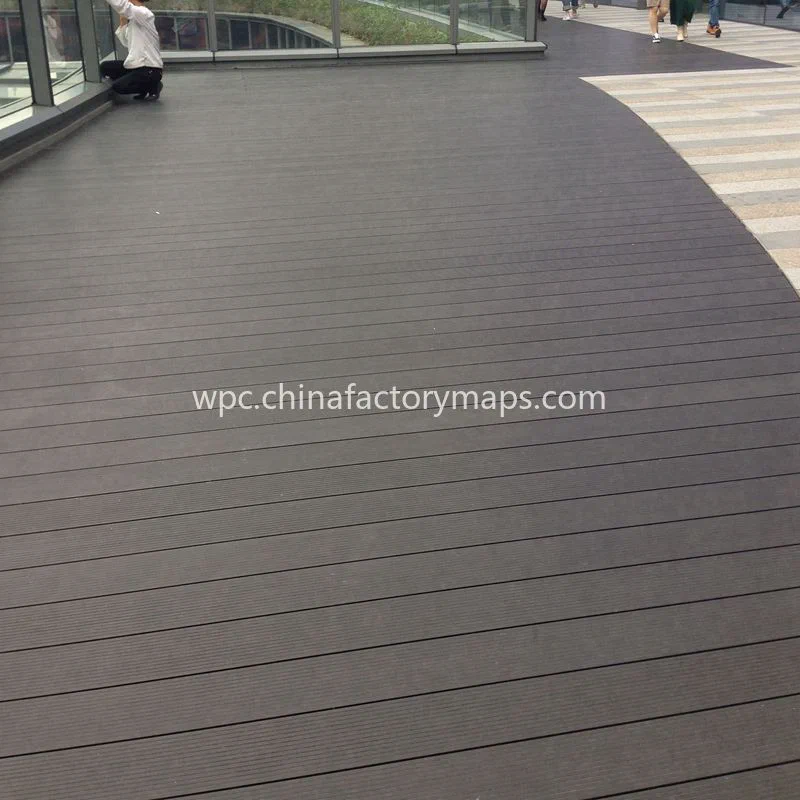
China’s composite decking factories are concentrated in several manufacturing provinces, with Guangdong accounting for the largest cluster in the directory’s current map. Anhui, Shandong and Zhejiang form additional production centres, while Shanghai and Jiangsu provide smaller groups. These locations offer different combinations of manufacturing capacity, industrial supply networks and access to export ports, all of which affect regional sourcing decisions.
Where the factory clusters are located
Guangdong has the largest mapped concentration, with 22 listed suppliers across Foshan, Guangzhou and Zhuhai. The province has an established building materials manufacturing base, supported by plastics processing, extrusion equipment suppliers and access to industrial labour. These factors provide a practical foundation for WPC production, where manufacturers combine wood-based fillers and thermoplastics through controlled mixing and extrusion. The concentration also gives overseas buyers several suppliers to investigate within the same broad region. Shenzhen Port and Guangzhou Port are relevant export gateways, although the actual shipping route depends on each factory’s location, transport arrangements and freight service.

Anhui has nine listed suppliers, including factories in Xuancheng, Suzhou and Guangde. Its position in the mapped supplier network makes it a separate sourcing region rather than simply an extension of the coastal manufacturing belt. Inland industrial locations can offer access to manufacturing land, regional labour and supporting materials businesses. Buyers comparing Anhui factories should examine how production facilities obtain polymer resins, wood flour, additives and extrusion components. The distance between a factory and its preferred export gateway also matters. Shanghai Port and Ningbo-Zhoushan Port are relevant options for evaluating outbound logistics, but the most suitable route should be established using the factory’s actual dispatch location.

Shandong accounts for seven mapped suppliers, including Zibo, Linyi and Qingdao. The province has a substantial industrial and materials-processing base, while Qingdao provides an established coastal export gateway. For buyers, this combination makes factory location an important part of the comparison. A supplier closer to Qingdao may have a different inland transport profile from one operating further inland. Zhejiang has six listed suppliers across Huzhou, Jiaxing and Hangzhou. Its manufacturing network sits within a wider regional industrial economy, with access to Ningbo-Zhoushan Port and Shanghai Port. These coastal connections can simplify freight planning, although port proximity alone does not establish a factory’s production capability or shipping cost.
What regional concentration means for buyers
The map is useful because supplier selection involves more than identifying factories that manufacture the same product. Guangdong offers the broadest mapped choice, while Anhui, Shandong and Zhejiang provide alternative locations for comparing production arrangements and logistics. Shanghai has three listed suppliers, and Jiangsu has two, including Nanjing. Their smaller mapped presence does not establish lower manufacturing capability. It simply indicates that the directory currently records fewer suppliers in those locations. Buyers searching for composite decking to buy should compare the factory’s actual production operation rather than assume that supplier concentration automatically indicates product quality or available capacity.
Raw material access and extrusion capability deserve particular attention. WPC decking depends on the consistency of its wood-plastic formulation, mixing process, extrusion temperature and cooling conditions. Factories may differ in their experience with solid and hollow profiles, surface treatments, colour formulations and co-extrusion structures. Regional industrial networks can support these processes, but a location on the map cannot verify them. Buyers should request product specifications, production photographs, samples and details of quality-control procedures. They should also establish whether the listed supplier manufactures the decking itself or operates primarily as a trading company.
Port distance provides another useful comparison. The directory covers Shanghai Port, Ningbo-Zhoushan Port, Shenzhen Port, Qingdao Port, Guangzhou Port, Tianjin Port, Xiamen Port, Taicang Port, Beibu Gulf Port, Rizhao Port, Lianyungang Port and Yingkou Port. Not every port is equally relevant to every factory. Inland trucking, container availability, customs arrangements and the shipping line’s destination coverage all affect the final route. Buyers should compare the complete factory-to-port journey rather than relying on straight-line map distance. A slightly more distant supplier may still offer a practical shipping arrangement if its established freight connections are better suited to the destination market.

Product specifications also need to be checked independently of location. WPC decking expands and contracts with temperature changes, so installation requires appropriate board gaps and a ventilated supporting substructure. The material resists moisture and insect damage, but it is not indestructible. Sustained ultraviolet exposure can also cause colour fading. Buyers should therefore request installation guidance, dimensional tolerances, surface-performance information and details of the intended application. The geographic map helps narrow the supplier search; factory verification and technical assessment establish whether a particular source meets the purchasing requirements.

FAQ
Q: Which Chinese province has the largest mapped concentration of WPC decking factories?
A: Guangdong has the largest concentration in the current directory, with 22 listed suppliers across Foshan, Guangzhou and Zhuhai.
Q: Which export ports should buyers compare when sourcing composite decking from China?
A: Relevant ports include Shenzhen Port, Guangzhou Port, Qingdao Port, Shanghai Port and Ningbo-Zhoushan Port. The appropriate choice depends on the factory’s location, inland transport arrangements and the destination shipping route.
Related Articles
Featured Suppliers
Verified premium suppliers on our map.
