
Wood-Plastic Composite Decking Tiles vs. Interlocking Plastic Tiles
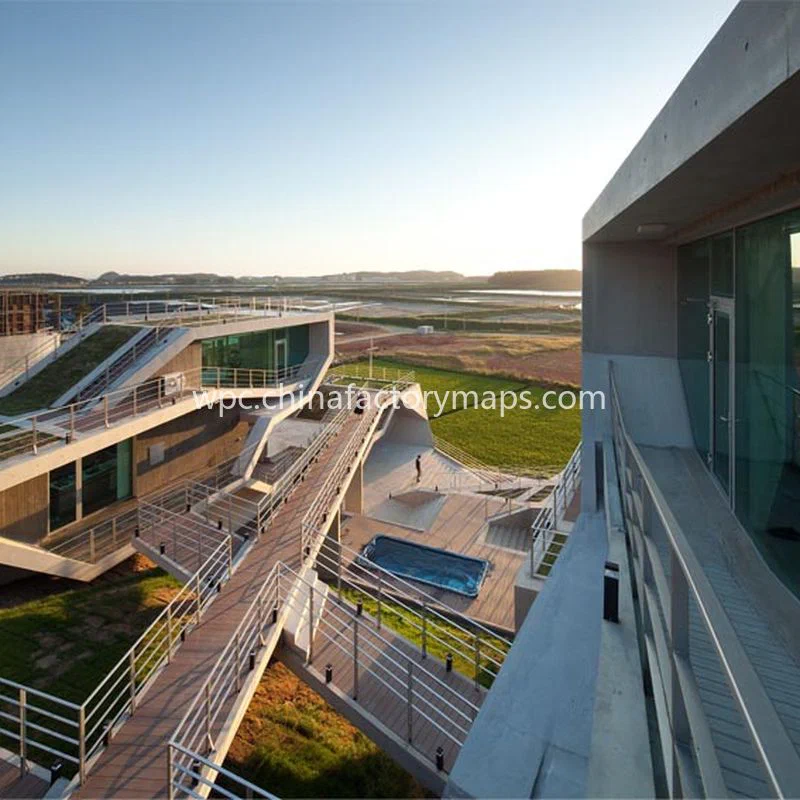
Wood-plastic composite decking tiles and interlocking plastic tiles are both used for outdoor flooring, but their construction leads to different performance characteristics. The main differences concern surface material, structural support, thermal movement, drainage and installation requirements. For overseas buyers sourcing either product from China, these details matter more than appearance alone.
Material and construction differences
WPC decking tiles typically combine wood fibre or wood flour with thermoplastic polymers and additives. The material is moulded or extruded into a composite surface designed to retain some of the appearance and texture of natural timber. Most modular WPC tiles consist of a composite top layer attached to a plastic support grid. The grid raises the walking surface and provides channels for water drainage.

Interlocking plastic tiles are generally manufactured from polypropylene or another thermoplastic. Their structure may be an open-grid design, a perforated surface or a solid modular panel, depending on the intended application. The interlocking mechanism is usually integrated into the tile edges, allowing adjacent units to connect without conventional mechanical fasteners. Unlike WPC, these tiles do not contain a wood-based component unless the product is specifically formulated as a composite.
This distinction affects surface characteristics. WPC offers a more timber-like appearance and can provide a textured walking surface. Plastic tiles tend to have a more uniform polymer appearance, although moulded patterns and surface finishes vary. Buyers should examine the actual surface profile rather than relying on product photographs, particularly when slip resistance is a requirement.
Performance, installation and application

Moisture resistance is relevant to both categories, but neither should be treated as automatically waterproof flooring in every installation. WPC generally resists moisture absorption better than untreated wood and is less susceptible to insect damage. However, prolonged water exposure, standing moisture and poorly ventilated installations can still create problems. Plastic tiles do not absorb water in the same way as wood-containing composites, but drainage depends on the tile design and the condition of the underlying surface.
Thermal movement is another important distinction in product selection. WPC expands and contracts as temperatures change. Installation therefore requires appropriate gaps between tiles and sufficient clearance around fixed structures. The supporting surface must also allow ventilation and drainage. Plastic tiles experience thermal movement too, although the degree depends on polymer formulation, tile dimensions and construction. Buyers should request the manufacturer’s installation tolerances rather than assume that all interlocking systems can be installed tightly together.
Fastening methods differ according to the product structure. Modular WPC tiles commonly rely on an integrated plastic base with connecting edges, while larger composite decking systems may use clips or screws. Interlocking plastic tiles generally connect through moulded tabs or clips. These connections make individual tile replacement relatively straightforward, but connection strength and resistance to repeated movement should be checked. A sample assembly can reveal whether the joints remain secure under normal foot traffic.
The application also influences the appropriate choice. WPC tiles are commonly considered for balconies, patios, garden seating areas and poolside surroundings where a timber-style finish is preferred. Interlocking plastic tiles are used in utility areas, temporary flooring, workshops and outdoor spaces where modular assembly and straightforward replacement are priorities. For wet areas, the surface texture, drainage openings and slip performance require particular attention. Neither material should be selected solely on the assumption that its surface will remain safe when wet.

UV exposure introduces another trade-off. Sustained sunlight can gradually fade WPC colour, while prolonged exposure can also affect the appearance and mechanical properties of plastic tiles. Formulations containing UV stabilisers may improve outdoor performance, but the actual result depends on material composition and exposure conditions. Buyers should request information about colour stability and relevant outdoor ageing tests. A darker colour may also absorb more heat, which can affect surface temperatures and thermal movement.
Sourcing considerations in China
China’s mapped WPC supplier base provides several geographical points for comparing manufacturing options. Guangdong has the largest listed cluster, including Foshan, Guangzhou and Zhuhai. Anhui includes suppliers around Xuancheng, Suzhou and Guangde, while Shandong has mapped production locations in Zibo, Linyi and Qingdao. Zhejiang, Shanghai and Jiangsu provide additional sourcing locations. These clusters give buyers a practical starting point for identifying manufacturers of wood plastic composite decking tiles and related modular flooring products.
Geographical proximity to an export port is a separate consideration from factory capability. Suppliers in Guangdong can be compared against access to Shenzhen Port and Guangzhou Port, while manufacturers in Zhejiang can be assessed in relation to Ningbo-Zhoushan Port. Shanghai and Jiangsu suppliers can be evaluated against Shanghai Port and Taicang Port. Shandong manufacturers may be compared with Qingdao Port and Rizhao Port. A map-based directory helps narrow the search, but actual transport arrangements depend on the factory’s location, inland haulage and shipping schedule.
Before requesting quotations, buyers should establish whether a supplier manufactures the composite surface, the supporting base and the connecting components in-house or purchases some components externally. Product samples should be checked for dimensional consistency, joint fit, surface texture and support-grid strength. Technical documentation should identify the polymer type, wood content where applicable, UV stabilisation and recommended installation clearances. Comparing these details across suppliers makes product specifications easier to assess than comparing catalogue descriptions alone.
FAQ
Q: Are WPC decking tiles and plastic interlocking tiles interchangeable?
A: Not necessarily. They have different surface materials and structural characteristics, so suitability depends on the intended application, loading conditions and installation environment.
Q: Do WPC decking tiles require expansion gaps?
A: Yes. WPC expands and contracts with temperature changes, so installers must follow the manufacturer’s spacing requirements and maintain appropriate clearance around fixed structures.
Q: Which Chinese regions can buyers investigate for WPC suppliers?
A: Guangdong, Anhui, Shandong, Zhejiang, Shanghai and Jiangsu are the six supplier clusters currently mapped by ChinaFactoryMaps.
Related Articles
Featured Suppliers
Verified premium suppliers on our map.
