
WPC Balcony Railings: Comparing Solid and Hollow Profiles
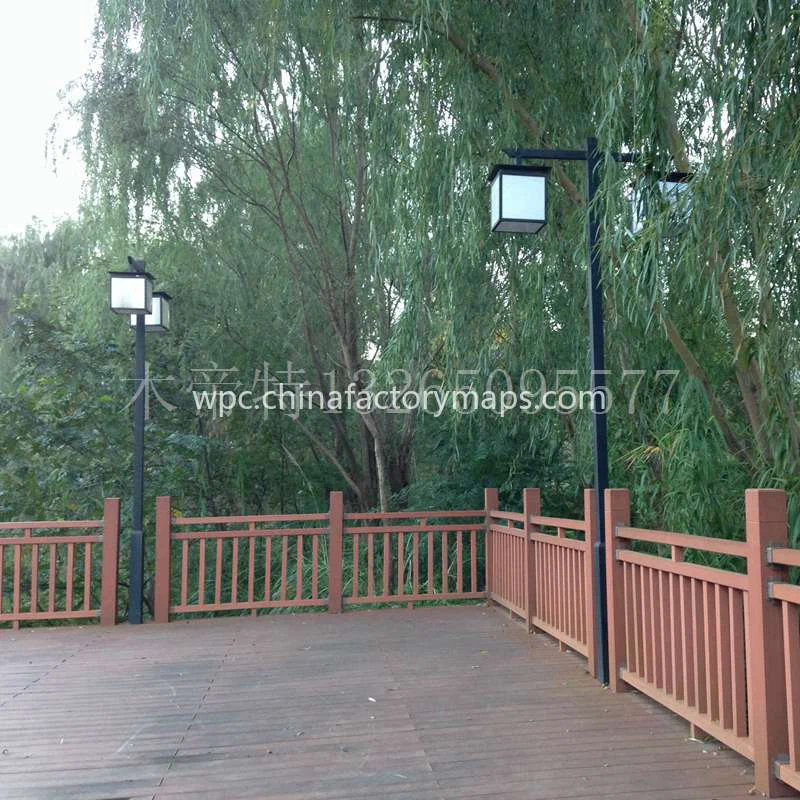
WPC balcony railings are commonly supplied with solid or hollow profiles, and the difference affects weight, internal structure, fastening and installation requirements. For overseas buyers sourcing wpc balkongeländer from China, comparing these constructions helps establish which profile suits the railing design, expected loading conditions and installation environment.
Solid WPC profiles contain material throughout their cross-section, giving them greater mass and a more substantial structure than hollow alternatives of comparable external dimensions. This construction can be useful for railing components that require a solid fixing area, particularly posts, connector sections and decorative elements. However, a solid profile is not automatically suitable as a structural safety component. Its load-bearing capacity depends on the material formulation, profile dimensions, reinforcement, connection design and manufacturing consistency. Hollow profiles use internal cavities to reduce material consumption and overall weight. Their external dimensions can resemble those of solid sections, but the internal walls and connecting ribs determine how effectively they resist bending and local pressure. Thin-walled hollow sections may deform around poorly positioned screws or under concentrated loads. Buyers should therefore request cross-sectional drawings rather than compare profiles by external dimensions alone. Wall thickness, cavity arrangement and the geometry of internal ribs are relevant specifications. Where railing components must meet building safety requirements, test evidence for the complete railing assembly is more useful than a general statement about WPC strength.

The practical choice also depends on how the railing will be assembled. Solid profiles can provide more flexibility when screws or mechanical connectors need to engage material through the section, although pilot holes, edge distances and suitable fasteners still matter. Hollow profiles require closer attention to fixing locations. Screws placed near cavity edges may have limited holding strength, so manufacturers may specify internal inserts, metal reinforcement or dedicated connection brackets. These details affect both installation time and the final appearance of the railing. WPC also expands and contracts as temperatures change. Long horizontal rails need suitable movement gaps, while connection details must allow for dimensional movement without loosening or creating excessive stress. The supporting structure should provide adequate ventilation and drainage. Trapped moisture around connections can contribute to deterioration of adjacent materials, even though WPC itself generally resists moisture absorption and insect damage better than untreated timber. Neither profile type eliminates the need for correct spacing, support and fastening. Buyers should obtain installation drawings showing post spacing, fixing methods, expansion allowances and the recommended substructure before confirming an order.

Surface construction and outdoor exposure introduce further differences. Some WPC railing profiles use a conventional composite formulation throughout, while others have a capped or co-extruded outer layer designed to improve surface resistance to staining and weather exposure. A capped surface does not change the need to assess the underlying profile structure. It also does not make the product immune to scratches, impact or prolonged ultraviolet exposure. Colour can fade under sustained sunlight, with the extent depending on the formulation, pigments, surface layer and exposure conditions. Solid profiles contain more material, but that alone does not guarantee better colour retention or weather performance. Hollow profiles can perform adequately outdoors when their wall structure, surface formulation and drainage details are properly specified. For coastal balconies, buyers should pay particular attention to the corrosion resistance of screws, brackets and reinforcement, since these components may be more vulnerable to salt exposure than the composite itself. Sample testing under relevant exposure conditions can help distinguish products that have similar catalogue descriptions but different surface performance.

China’s mapped WPC supplier clusters provide several sourcing routes for comparing these profile options. Guangdong has the largest listed cluster, with suppliers in Foshan, Guangzhou and Zhuhai. Anhui includes manufacturers around Xuancheng, Suzhou and Guangde, while Shandong listings cover Zibo, Linyi and Qingdao. Zhejiang suppliers are mapped around Huzhou, Jiaxing and Hangzhou, with additional listings in Shanghai and Nanjing in Jiangsu. Geographic position also affects export planning. Buyers comparing Guangdong suppliers may examine access to Shenzhen Port and Guangzhou Port, while Zhejiang and Shanghai listings can be assessed against Ningbo-Zhoushan Port and Shanghai Port. Shandong sourcing can be considered alongside Qingdao Port and Rizhao Port. Proximity to a port is a useful screening factor, but it does not establish a factory’s actual shipping arrangements or total logistics cost. Supplier enquiries should request the same information from each shortlisted manufacturer: profile cross-sections, wall thicknesses, material composition, reinforcement details, fastening specifications, UV exposure data and assembly test reports. Comparing equivalent technical information makes the distinction between solid and hollow profiles more meaningful than catalogue appearance or nominal weight alone.

FAQ
Q: Are solid WPC balcony railing profiles stronger than hollow profiles?
A: Not necessarily. Strength depends on dimensions, wall construction, material formulation, reinforcement and connection design, so complete assembly test results should guide the comparison.
Q: Are hollow WPC railing profiles suitable for outdoor balconies?
A: Yes, provided their wall thickness, internal structure, fastening system and surface formulation are suitable for the intended exposure and loading conditions.
Q: What should buyers request from Chinese WPC railing manufacturers?
A: Request cross-sectional drawings, material specifications, reinforcement details, installation instructions, UV performance information and test evidence for the assembled railing system.
Featured Suppliers
Verified premium suppliers on our map.
